http://www.barbaraannderksen.com/2013/03/26/born-between-1935-1955-read-on
An excellent reminder of a HUGE generation gap
Tuesday, April 16, 2013

Tuesday, April 2, 2013
The One Flaw in Women
The One Flaw in Women
Follow this link for an inspirational message, then leave a comment telling what about this video touched you the most.
Follow this link for an inspirational message, then leave a comment telling what about this video touched you the most.
Tuesday, February 5, 2013
WHY ARE WE LETTING THIS HAPPEN !!! ??? !!!

Nearly half the world – over three billion people – live on less than $2.50 a day.
According to UNICEF, 26,500-30,000 children die each day due to poverty – that’s 18 children dying every minute, a child every three seconds.
About 1.1 billion people in developing countries have inadequate access to water, and 2.6 billion lack basic sanitation.
For the 1.9 billion children from the developing world: 640 million are without adequate shelter, 400 million do not have access to safe water, 270 million do not have access to health services.
About 2.2 million children die each year because they are not immunized.
About 1.6 billion people – a quarter of humanity – live without electricity.
Over nine million people, of which five million are children, die worldwide each year because of hunger and malnutrition.
Over 11 million children die each year from preventable causes like malaria, diarrhea and pneumonia.
About 20% of the population in the developed nations consume 86% of the world’s goods.

poorest 40% of the world’s population accounts for 5% of the global income. The richest 20% accounts for 75% of world income.
Around 27-28% of all children in developing countries are estimated to be underweight or stunted.
Tuesday, January 8, 2013
Violence and Toys
Teachers Resisting Unhealthy Children’s Entertainment
TRUCE 2004-2005
Toy Action Guide
P lay is essential to children’s healthy development and learning. Children use play to actively construct knowledge, meet social/emotional needs, and acquire life skills. The content of their play comes from their own experiences. Changes in today’s childhood are undermining play. Because of the pervasive influence of the electronic media — such as TV, movies, videos, DVDs, computers — children spend more time sitting in front of a screen and less time playing creatively with each other.
Toys, the tools of children’s play, influence that play. Toys of value enhance children’s natural ability to engage in imaginative, meaningful play by allowing them to try out their own ideas and solve their own problems. Many of today’s toys are highly structured and often linked to popular media images and programs. These toys channel children into imitative play, robbing them of opportunities to use their own imaginations, creativity, and problem solving skills.
Parents are constantly faced with decisions about what toys to buy and what toys to avoid. High-powered marketing and the influence of popular culture interfere with thoughtful decision-making at the toy store.
This guide is intended to help adults promote children’s creative and constructive play by making informed choices about toys, and by working with others at home, school, and in the community to promote positive play and toys.
P lay is essential to children’s healthy development and learning. Children use play to actively construct knowledge, meet social/emotional needs, and acquire life skills. The content of their play comes from their own experiences. Changes in today’s childhood are undermining play. Because of the pervasive influence of the electronic media — such as TV, movies, videos, DVDs, computers — children spend more time sitting in front of a screen and less time playing creatively with each other.
Toys, the tools of children’s play, influence that play. Toys of value enhance children’s natural ability to engage in imaginative, meaningful play by allowing them to try out their own ideas and solve their own problems. Many of today’s toys are highly structured and often linked to popular media images and programs. These toys channel children into imitative play, robbing them of opportunities to use their own imaginations, creativity, and problem solving skills.
Parents are constantly faced with decisions about what toys to buy and what toys to avoid. High-powered marketing and the influence of popular culture interfere with thoughtful decision-making at the toy store.
This guide is intended to help adults promote children’s creative and constructive play by making informed choices about toys, and by working with others at home, school, and in the community to promote positive play and toys.
Violent events such as the war in Iraq and the post-war conflict, acts of terrorism, crime,* and
natural disasters affect everyone. Children receive different information about these events.
Some children are included in discussions, some overhear adults’ or other children’s talk, some
hear or see it on the news. Many young children may be confused or frightened and try to
work out their feelings and understanding in play. Adults can observe and guide the play by
responding to what children say with simple, accurate information and keeping the play
within safe physical and emotional boundaries. Remember: each time a child sees a replay of an event on television, it is a new event in their minds. Imagine how many buildings fell in children's minds when the Twin Towers fell in 2001.
For more information contact TRUCE: www.truceteachers.org
PO Box 441261, West Somerville, MA 02144 • e-mail: truceteachers@aol.com
PO Box 441261, West Somerville, MA 02144 • e-mail: truceteachers@aol.com
PLEASE COPY AND DISTRIBUTE
* Experiences such as the recent criminal behavior in Newtown CT
Tuesday, October 23, 2012
Explore the Mysteries of Heaven
Bostrom, Kathleen
Long. Elena Kucharik, illustrator. What about
Heaven? (Little Blessings Series) Tyndale House Publishers.
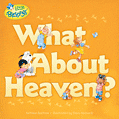 Hardcover. 2/26/2000.
80 pages. List price $9.99. ISBN-10: 0842373535. ISBN-13: 978-084237531.
Hardcover. 2/26/2000.
80 pages. List price $9.99. ISBN-10: 0842373535. ISBN-13: 978-084237531.
Paperback.
9/28/2012. 32 pages. List price $3.99. ISBN-10:1414375107. ISBN-13: 1414375106.
EBook. 11/1/2012.
List price $3.99. ASIN B007V69BD8.
Stars: 5 -
Outstanding FYC- for Families with Young Children
What about Heaven tackles many of the
questions children ask. Where is heaven? How will I find it? Who else will be
there? Will everyone know who I am? What will I eat? What will I wear? What
will I do? Is there room for animals? Will I get sick?
Bostrom
acknowledges the questions are all acceptable ones and while there are some we will
not understand the answers to until Jesus returns, the Bible has answers for
the rest. Each answer she gives, she backs up with scripture references placed
at the top of each page in small print. These references will help parents with
follow-on questions and references for family devotions.
Kucharik’s
illustrations support the content on each span of two pages. The pictures of multicultural
children appeal to young children. They will appreciate the illustrations from
other titles in the Little Blessings series.
Some illustrations are repeated from other titles such as God Loves You! also written by Bostrom, and The One Year Devotions for Preschoolers written by Crystal Bowman.
This repetition
of form assists children in making text to text connections (relating this book
to others they have read), an critical reading skill. The rhyming couplets, the font size, and the large
amount of white space on each page makes this a good, you-read-to-me book for
three through five year old children. First and second graders will enjoy the
book as an I-read-to-you book.
What about Heaven? Is not only a beautiful
book for young children and their parents, but will make an excellent addition
to church and public libraries. It will also find a suitable place in early
childhood classrooms and Sunday School rooms. What about Heaven? was nominated for the People’s Choice Award.

 Dr. Bostrom is an
accomplished author of numerous books for children and books for adults. She is
an ordained minister in the Presbyterian Church (USA) with degrees from
Princeton and McCormick Theological Seminaries. Elena Kucharik’s not only
creates colorful and captivating illustrations for the Little Blessings line, but was the lead artist and developer for
Care Bears. She also designs and illustrates for major corporations and
publishers.
Dr. Bostrom is an
accomplished author of numerous books for children and books for adults. She is
an ordained minister in the Presbyterian Church (USA) with degrees from
Princeton and McCormick Theological Seminaries. Elena Kucharik’s not only
creates colorful and captivating illustrations for the Little Blessings line, but was the lead artist and developer for
Care Bears. She also designs and illustrates for major corporations and
publishers.
I received a
complimentary paperback copy of this book from the Tyndale Blog Network for my
unbiased review.
Other books in the Little Blessings series include: Are Angels Real? – Blessings Come in Shapes – God Created Me! – Is God Always with Me? – The One Year Devotions for Preschoolers – The One Year Devotions for Preschoolers 2 – Questions from Little Hearts – Thank You, God! – What Is Prayer? – What Is the Bible? – Who Is Jesus? – Why Is There a Cross?
Tuesday, October 9, 2012
Family Literacy
The
Importance of Family Literacy
Family Literacy programs are designed to improve the
language and literacy skills of both parents and children. The majority are
designed for parents with preschool or early school-age children and aimed at
improving children's school readiness and success, while simultaneously
supporting the language/literacy development of parents. Most federal programs, such as Even Start,
have adopted a specific definition for family literacy that addresses four program
components. Most federally funded
programs must include all four components:
1. Early Childhood Education programs for children that are age-
appropriate and help prepare children for success in school and life.
2. Adult
Education, specifically, parent literacy training that leads to economic
self-sufficiency.
3. Parenting Education, training that
helps parents become teachers of
their children and full partners in
educational systems.
4. Parent and Child Together (PACT)
programming that enhances the
interaction
of parents and their children around language and literacy.
Need for Literacy and Language Programs well
documented.
- 1991 - in the Carnegie
Foundation report, Ready to Learn:
A mandate for the nation, teachers reported that 35% of
kindergarten children were not ready for school. The area in which children were reported
to be most lacking was in literacy and language skills (
Boyer, 1991).
- 1998 - the Annie E. Casey
Foundation reported that 39% of fourth-grade students scored below the
basic reading level nationwide.
- Children for whom English is a
second language are of particular concern
because their numbers are
increasing and they often have difficulty in school (Rossi &
Stringfield, 1995).
- Studies show that children who
start Kindergarten without basic language and literacy skills have
difficulty learning to read, and they continue to experience reading
problems throughout school (Snow, et al, 1998).
- Research on brain development
helps explain why early home and child care experiences are critical to
language development.
- By the time babies are a year
and a half old, the bottom 10% will understand around 90 different words
while the top 10% will understand
more than 300 words.
- Research indicates that children
who have books and other reading materials at home, as well as writing
materials, do better than children who have none.
- Children who see their parents
reading and writing do better than children who do not see such models.
- Children who have many opportunities
to talk and listen, practice eye-hand coordination
activities that will help develop the foundation skills for writing,
and "read" books," gain invaluable experience with
language.
- Working with parents to enrich
home environments, through family or intergenerational literacy programs,
increases the chance that preschoolers will succeed once they reach school
(Bus, van Ijzendoorn, & Pellegrini, 1995; Edwards, 1995; Edwards,
Pleasants, & Franklin, 1999; Jordan, Snow, & Porche, 2000; Neuman ,1996; Whitehurst, et al., 1988.
The foundation for literacy skills is set during the preschool years,
and it is during this time that young children develop the skills that will
help them be successful (Chall, Jacobs, & Baldwin, 1990). Whereas it was once thought that children
learned to speak and listen during their early years and later learned to read
and write at school age, we now know that they develop literacy related
abilities simultaneously from infancy.
Emergent literacy is the term used to describe young children's
developing literacy skills before formal schooling and encompasses the
constellation of speaking, listening, reading and writing skills young children
acquire (Teale & Sulzby, 1989).
There is
increasing interest in teaching parents how to help children build essential
literacy skills (Nickse, 1989). Research
has shown that parents can create supportive home literacy environments,
express positive attitudes about literacy, and share literacy activities such
as joint book reading (Arnold, Lonigan, Whitehurst & Epstein, 1994;
DeBaryshe & Binder, 1994; Payne, Whitehurst, & Angell, 1994).
Reading aloud with
children is probably the
single most important activity for building early literacy skills and
understanding in preschool age children (Wells, 1985; Bus & van Ijzendoorn,
& Pellegrini, 1995; Bus et al.; 1997; Whitehurst et al., 1994)
when:
·
children
feel emotionally secure
·
are
active participants in reading
·
parents
and caregivers engage the child - for example,
asking children to predict what will happen next
·
naming
and talking about the pictures
·
rereading
the story many times
·
helping
children link what is in the book with what is in their own lives
·
giving
the child many age-appropriate opportunities to build on book reading with activities that encourage an
understanding of "reading,"
"writing," listening and speaking.
In addition to reading aloud, parents also can:
·
improve
the quality and quality of verbal interaction with their children
·
show
interest, valuing, and encouragement of reading and language
·
provide
access to a wide range of reading, writing, and drawing materials
·
show
their own interest in literature and modeling of reading and writing in the
home
·
provide
opportunities for literacy experiences within routine family interactions and
activities.
References
Bialystok,
E., & Herman, J. (1999). Does bilingualism matter for early
literacy? Bilingualism: Language and cognition, 2(1), 35-44.
Boyer,
E. L. (1991). Ready to learn: A mandate from the nation. Princeton, NJ:
The Carnegie Foundation for the Advancement of Teaching.
Bus,
A., Belsky, J., van Ljzendoorn, & Crnic, K.
(1997). Attachment and
book-reading patterns: A study of
mothers, fathers, and their toddlers. Early
Childhood Research Quarterly, 12, 81-98.
Bus, A.G., van Ijzendorn, M.H., & Pellegrini,
A.D. (1995). Joint book reading makes for success in
learning to read: A meta-analysis on
intergenerational transmission of literacy, Review of Educational Research,
65(1), 1-21.
Edwards,
P.A. (1995). Empowering low-income
mothers and fathers to share books with young children. The Reading Teacher, 48, 558-564.
Edwards,
P.A., Pleasants, H.M., & Franklin,
S.H. (1999). A path to follow: Learning to listen to parents. Portsmouth, NH: Heinemann.
Jordan,
G.E., Snow, C. E., & Porche, M.V.
(2000). Project EASE: The effect of a family literacy project on
kindergarten students’ early literacy skills.
Reading Research Quarterly, 35(4), 524-546.
Learning
to read and write: Developmentally
appropriate practices for young children (1998). Young Children, 30-23.
Neuman,
Susan B. (1996). Children engaged in
storybook reading: The influence of
access to print resources, opportunity, and parental interaction. Early Childhood Research Quarterly, 11,
495-513.
Perez,
B. (1998). Language, literacy, and
biliteracy. In B. Perez (Ed.) Sociocultural
Contexts of Language and Literacy,
(pp. 21-48). Mahwah, NJ: Erlbaum.
Rossi,
R.J. & Stringfield, S.C.
(1995). What we must do for
students placed at risk, Phi Delta Kappan, 77, 73-76.
Snow, Catherine E., Burns, M. Susan,
& Griffin, Peg, (1998). Preventing
Reading Difficulties in Young Children.
National Research Council (U.S.). Committee on the Prevention of Reading
Difficulties in Young Children, National Acad. Press.
Wells, G. (1985).
Preschool literacy-related activities and success in school. In D.R. Olson, N. Torrence, & A. Hildyard
(Eds.), Literacy, language and learning:
The nature and consequences of reading and writing (pp. 229-255).
Cambridge, England: Cambridge
University Press.
Whitehurst,
G. J., Galco, F.L., Lonigan, C.J., Fischel, J.E., DeBarshe, B.D.,
Valdex-Menchaca, M.C. & Caulfield, M.
(1988). Accelerating language
development through picture book reading, Developmental Psychology, 24,
552-559.
General
Reading
Bridges
to Literacy: Children, Families, and
Schools. David K. Dickson (Ed.). Cambridge, MA: Blackwell Press, 1994.
Family
Literacy: Connections in Schools and
Communities. Lesley Mandel Morrow (Ed.). Washington, DC: International Reading Association, 1995.
The
Role of Family Literacy Environments in Promoting Young Children's Emerging
Literacy Skills. Pia Rebello Britto & Jeanne Brooks-Gunn
(Eds.). San Francisco: Jossey-Bass, 2001.
Literacy
Development in the Early Years: Helping
Children Read and Write. Lesley Mandel Morrow. Boston, MA:
Allyn & Bacon, 2001.
Tuesday, September 25, 2012
The Cost of Kids
The government recently calculated the cost of raising a child from birth to 18 and came up with approximately $300,000 (pre-tax dollars) for a middle income family (U.S. Department of Agriculture's 2011 Annual Report "Expenditures on Children by Families." (PDF) as analyzed by The Wall Street Journal 6/14/2012). Talk about sticker shock! That doesn't even touch college tuition. But $300,000 isn't so bad if you break it down. It translates into $17,647 a year, $1,471 a month, or $368 a week. That's a mere $53 a day! Just over $2.19 an hour (even while they are sleeping).
Parents who send their children to college can add a significant sum to the total. The report notes estimate by the College Board that in 2011-2012, annual average tuition and fees were $28,500 at 4-year private (non-profit) colleges, while annual room and board was $10,089.
Still, you might think the best financial advice says don't have children if you want to be "rich." It is just the opposite.
What do you get for your $300,000?
· Naming rights. First, middle, and last!
· Glimpses of God every day.
· Giggles under the covers every night.
· More love than your heart can hold.
· Butterfly kisses and Velcro hugs.
· Endless wonder over rocks, ants, clouds, and warm cookies.
· A hand to hold, usually covered with jam.
· A partner for blowing bubbles, flying kites, building sand castles, and skipping down the sidewalk in the pouring rain.
· Someone to laugh yourself silly with no matter what the boss said or how your stocks performed that day.
For $300,000, you never have to grow up.
· You get to finger-paint, carve pumpkins, play hide-and-seek, catch lightning bugs, and never stop believing in Santa Claus.
· You have an excuse to keep reading the Adventures of Piglet and Pooh, watching Saturday morning cartoons, going to Disney movies, and wishing on stars.
· You get to frame rainbows, hearts, and flowers under refrigerator magnets and collect spray painted noodle wreaths for Christmas, hand prints set in clay for Mother's Day, and cards with backward letters for Father's Day.
For $300,000, there is no greater bang for your buck.
· You get to be a hero just for retrieving a Frisbee off the garage roof, taking the training wheels off the bike, removing a splinter, filling a wading pool, coaxing a wad of gum out of bangs, and coaching a baseball team that never wins but always gets treated to ice cream regardless.
· You get a front row seat to history to witness the first step, first word, first bra, first date, and first time behind the wheel.
· You get to be immortal.
· You get another branch added to your family tree, and if you're lucky, a long list of limbs in your obituary called grandchildren or even great-grandchildren.
· You get an education in psychology, nursing, criminal justice, communications, and human sexuality that no college can match.
· In the eyes of a child, you rank right up there with God.
· You have all the power to heal a boo-boo, scare away the monsters under the bed, patch a broken heart, police a slumber party, ground them forever, and love them without limits, so one day they will, like you, love without counting the cost.
ENJOY YOUR KIDS AND GRANDKIDS AND GREAT-GRANDKIDS
Check out They Stood ALONE!: 25 Men and Women Who Made A Difference
Parents who send their children to college can add a significant sum to the total. The report notes estimate by the College Board that in 2011-2012, annual average tuition and fees were $28,500 at 4-year private (non-profit) colleges, while annual room and board was $10,089.
Still, you might think the best financial advice says don't have children if you want to be "rich." It is just the opposite.
What do you get for your $300,000?
· Naming rights. First, middle, and last!
· Glimpses of God every day.
· Giggles under the covers every night.
· More love than your heart can hold.
· Butterfly kisses and Velcro hugs.
· Endless wonder over rocks, ants, clouds, and warm cookies.
· A hand to hold, usually covered with jam.
· A partner for blowing bubbles, flying kites, building sand castles, and skipping down the sidewalk in the pouring rain.
· Someone to laugh yourself silly with no matter what the boss said or how your stocks performed that day.
For $300,000, you never have to grow up.
· You get to finger-paint, carve pumpkins, play hide-and-seek, catch lightning bugs, and never stop believing in Santa Claus.
· You have an excuse to keep reading the Adventures of Piglet and Pooh, watching Saturday morning cartoons, going to Disney movies, and wishing on stars.
· You get to frame rainbows, hearts, and flowers under refrigerator magnets and collect spray painted noodle wreaths for Christmas, hand prints set in clay for Mother's Day, and cards with backward letters for Father's Day.
For $300,000, there is no greater bang for your buck.
· You get to be a hero just for retrieving a Frisbee off the garage roof, taking the training wheels off the bike, removing a splinter, filling a wading pool, coaxing a wad of gum out of bangs, and coaching a baseball team that never wins but always gets treated to ice cream regardless.
· You get a front row seat to history to witness the first step, first word, first bra, first date, and first time behind the wheel.
· You get to be immortal.
· You get another branch added to your family tree, and if you're lucky, a long list of limbs in your obituary called grandchildren or even great-grandchildren.
· You get an education in psychology, nursing, criminal justice, communications, and human sexuality that no college can match.
· In the eyes of a child, you rank right up there with God.
· You have all the power to heal a boo-boo, scare away the monsters under the bed, patch a broken heart, police a slumber party, ground them forever, and love them without limits, so one day they will, like you, love without counting the cost.
ENJOY YOUR KIDS AND GRANDKIDS AND GREAT-GRANDKIDS
Check out They Stood ALONE!: 25 Men and Women Who Made A Difference
Tuesday, September 18, 2012
Current Trends in Child Care of Infants and Toddlers
Urie Bronfenbrenner’s Ecological System
Microsystem
– effects that adults and children have on each other – the closest system to
the child. – contains the child, the immediate nuclear family, and specialists
relating to the child
Mesosystem
– includes child care settings – fosters children’s development by encompassing
connections between home, school, child care center and neighborhood
Exosystem
– Social setting s that do not contain the child, but still directly affect
their development – community health and social services and other public
agencies – grass roots groups who lob by and advocate for child care services –
it includes such issues as parent education and parent workplace
Macrosystem
– child is ultimately affected by decisions made at this level – consists of
laws, customs, and general policies of the social system (government) – this is
where the availability of resources (money) are determined.
Chronosystem- child is affected by world events and natural disasters - this is where the times affect growth and development particularly in the emotional domain
How do these considerations fit within Bronfenbrenner’s Ecological System?
Demographics
Quantity
vs. quality
·
26 % of population is children under 18 down
form 36% in 1964 projected 24% in 2020
·
In 2001 61% of children from birth through age 6
(not yet in kindergarten) received some form of child care on a regular basis
from persons other than parents
·
In 1997, nearly half of preschoolers (children
under age 5) with working mothers were primarily cared for by a relative while
their mother worked, while 22% were primarily cared for my non-relatives in a
home-based environment and another 22 percent were care for in a center-based
arrangement.
·
Children were more likely to engage in some kind
of organized before- or after-school activity as they aged. For example, in 2001, 27% of kindergarten
through 3rd graders and 39% of 4th-through-8th
graders participated in sports.
·
The birth rate for adolescents continued to
decline in 2000 to 27 births per 1000 females ages 15-17, representing the
lowest rate ever recorded. The bulk of
the drop in the adolescent birth rate occurred between 1991 and 2000, when it
dropped by nearly one-third.
·
In 2001 the percentage of high school graduates
ages 25 to 29 who continued their education and received a bachelor’s degree
remained at the all-time high of 33%, which was achieved in 2000. The percentage of black non-Hispanic high
school graduates who earned a bachelor’s degree increased for 14% in 1985 to
20% in 2001.
·
Between 1988 and 1993, the number of children in
childcare increased nearly 1.5 million to a total of more than 10 million in
the fall of 1993.
·
In 1996 the Personal Responsibility and Work
Opportunity Reconciliation Act was signed into law. Designed to break the cycle of poverty by
moving people from welfare into the workforce.
State governments were given the power to regulate funds and set
parameters for child care training.
Allowed people to provide unpaid child care as a way to meet the work
requirement.
·
In the State of Texas the regulating body for
childcare centers is the Texas Department of Protective and Regulatory
Services. The regulations are contained
in the Minimum Standards. The state of
Texas regulations rate 48th in terms of quality indicators.
·
5.4 million children lived in households headed
by a relative other than a parent in 1998.
2.13 million of these children lived with relatives, most often
grandparents, with no parent present.
·
In Texas 23.6% of children live in poverty
·
1 in 3 children is born to unmarried parents
·
1 in 2 children will live in a single parent
family at some point in childhood
·
1 in 4 children lives with only one parent
Fees
·
Poverty rate for children living with family
members has decreased substantially since 1993 when it reached a high of 22
percent. In 2000, 16% of children lived
in families with incomes below the poverty threshold. This percentage, also observed in 2999,
represents the lowest poverty rate among children since 1979.
·
The decrease in poverty is apparent for children
living in female-householder families and is more pronounced for black
children. Among black children in
female-householder families, about two-thirds lived below the poverty line from
1980 to 1993, and for the first time since 1980, fewer than half were living in
poverty in 2000.
·
The percentage of children who had at least one
parent working full time, all year steadily increased from 70% in 1980 to 80
percent in 2000. In 2000, 91% of
children living in two-parent families had at least one parent working full
time, all year. This percentage was
lower for children living in single male-headed families and single
female-headed families (67% and 50% respectively)
·
Texas has the second largest number of children
on the waiting list for child care assistance.41, 240, yet funding has been cut
for the third year in a row.
·
In 2001 the percentage of high school graduates
ages 25 to 29 who continued their education and received a bachelor’s degree
remained at the all-time high of 33%, which was achieved in 2000. The percentage of black non-Hispanic high
school graduates who earned a bachelor’s degree increased for 14% in 1985 to
20% in 2001.
·
The percentage of children whose parents have
less than a high school diploma is much higher among children with a
foreign-born parent. In 2001, 42% of
foreign-born children with at least one foreign-born parent had a parent with
less than a high school diploma, compared with 35% of native children with at
least one foreign-born parent and 11% of native children with native parents.
·
In 1996 the Personal Responsibility and Work
Opportunity Reconciliation Act was signed into law. Designed to break the cycle of poverty by
moving people from welfare into the workforce.
State governments were given the power to regulate funds and set
parameters for child care training.
Allowed people to provide unpaid child care as a way to meet the work
requirement.
·
The national average compensation for childcare
workers is $.15 above minimum wage.
·
Parents primary concerns in selecting a
childcare setting are cost and convenience to work or home.
·
Children with special needs
·
Research indicates that high quality early care
and education programs are not available to most families – especially
low-income families. Only 10 % of
classrooms staff at centers serving predominantly low-income families had a
two-year college degree or more, compared to 61% of classroom staff at centers
serving moderate- to high-income families.
Programs
Health
·
In 2000, 0.8% of children lived in households
reporting child hunger, down from 1.0% in 1998.
In 2000, 18% of children lived in households reporting any level of food
insecurity, down from 20% in 1998.
Children in families below the poverty line were nearly three times more
likely to experience food insecurity and hunger than children in families with
incomes above the poverty line.
·
According to the Healthy Eating Index, the
proportion of children ages 2 to 5 with good diets improved from 21% to 27%
between 1996 and 1998, reversing the decline form 1995 and 1996. Children living in poverty were less likely
than higher-income children to have a diet rated as good. In 1998 for children ages 2 to 5, 22 percent
of those living in poverty had a good diet, compared with 29% of those living
above the poverty line.
·
Children living in poverty tend to be in poorer
health than children living in higher-income families. Nevertheless, this gap narrowed between 1984
and 2000. In 1984 62% of children living
in poverty and 83% of children living at or above poverty were reported to be
in very good or excellent health. By
2000, 70% of children living in poverty and 85% of children living at or above
poverty were in very good or excellent health.
·
While infant mortality rate did not decline in
1998 there was a significant drop in 1999, to 7 deaths per 1,000 live births.
·
Mortality for children ages 5 to 14 declined
between 1998 and 1999. However, there
was no significant change in mortality rates for children ages 1 to 4.
·
The number of infants acquiring AIDS during
their mother’s pregnancy began to decline sharply by the mid 1990’s mainly
because infected pregnant women were treated with ZDV to prevent prenatal
transmission of AIDS. Before the availability of this treatment and estimated
1000-2000 infants were born with HIV infection each year. However, 59% of all pediatric AIDS cases
reported to the CDC through June 2000 are among Black children and 23%are among
Hispanic population.
·
Significant findings that document a
relationship between loss of TANF benefits and children suffering from ill
health and inadequate food in there homes have just been published by a group
of medical researchers. Pediatricians
and other researchers conducted a six-city study of the impact of TANF
sanctions on the health of intents and toddlers (under age 3) and found that
children in families that lost benefits because of non-compliance with TANF
rules were more likely to have been hospitalized and to go without food
compared with families that did not loose benefits.
·
Many local services (Brazos Valley) are losing
thousands of dollars to state budget cuts in 2004 and 2005.
o Children’s
Health Insurance Programs (CHIP) from $25,000 in 2003 to $22,000 in 2004.
(-12%) Dental and mental health coverage
are eliminated and waiting period for coverage has been increased to 90 days. The State is discouraging outreach and
enrollment of new members
o Twin
City Mission – Phoebe’s Home – from $224,598 in 2004 to $220,394 in 2005
(-2%) All funding requires a dollar for
dollar match.
o Brazos
Valley Community Action Agency – oversees CCMS that provides child care
subsidies - plan is to cut Community Oriented Primary Care program, a medical
outlet for the uninsured.-from $340,000 in 2003 to $289,000 in 2004 (-15%) Major cuts the year before taken from Quality
Initiatives (training for child care providers) It is possible that the COPC
funding could be cut entirely.
o MHMR
Authority of Brazos County – oversees ECI - from $10,802,781in 2003 to
$9,884,138 in 2004 (-8.5%)
o Family
Outreach is being forced to fund it’s own case work manager for the first time
in 15 years. A 100% cut in state monies
– 34 agencies statewide have closed or are planning to close their doors.
Diversity and Cultural
differences
·
Racial and ethnic diversity continue to
increase. In 2000 64% of children were
white, non-Hispanic, 15% were black non-Hispanic, 4 % were Asian/Pacific
Islander, and 1% were American Indian/Alaska Native. The number of Hispanic children has increased
faster than that of any other racial and ethnic group, growing from 9$ of the
child population in 1980 to 16% in 2000.
·
The foreign-born population of the United States
has increased dramatically over the past few decades. In 1994, 15% of children living in the U.S.
had at least one foreign-born parent; by 2001 this had increased to 19% of
children.
·
The percentage of children whose parents have
less than a high school diploma is much higher among children with a
foreign-born parent. In 2001, 42% of
foreign-born children with at least one foreign-born parent had a parent with
less than a high school diploma, compared with 35% of native children with at
least one foreign-born parent and 11% of native children with native parents
·
Children with special needs.
·
At about the age of 24 to 36 months children
begin to notice differences in skin color and other characteristics that make
one person different from another.
Depending on how this is handled at home and in the classroom children
learn acceptance or bias.
Brain research
·
Brain research indicates that the quality of
experiences a child has before the age of three has a great impact on their
learning. Critical windows of opportunity
occur during these vital years for everything from trust to learning.
Violence
·
At about the age of 24 to 36 months children
begin to notice differences in skin color and other characteristics that make
one person different from another.
Depending on how this is handled at home and in the classroom children
learn acceptance or bias.
·
In the wake of 9/11/01 and increased violence in
schools, there has been an increased emphasis through programs dealing with
emotional intelligence. For example,
NAEYC has instituted ACT: Adults and
Children Together, a program designed to help young children deal with
conflict, anger and frustration in non-violent constructive ways.
·
Last year (2002) their were 218 confirmed
reports of abuse involving 350 children in Bryan College Station.
Professional Development
Child Care workers
·
Childcare workers have the highest turnover rate
of any occupation in the United States, averaging 32%. This turnover is due to burnout,
inconsistency, instability, and decreases the ability of programs to meet
children’s individual needs as well as parental needs for support.
·
The use of mentors to encourage new workers has
become a creative answer for extending childcare resources. In 1996 mentor programs existed in 40
communities across the country. It
created a new step in the career ladder by acknowledging the specialized skill
of teaching others to care for and educate young children combined with
financial reward.
·
In Texas Child Care Management Services has
established a Quality Initiatives program that provides free and inexpensive
training for child care workers.
·
Nationally, the Child Development Associate
program has provided a step on the career ladder emphasizing credentialing
providers of child care for young children through strong legislative backing,
training efforts and collegiate support.
The program emphasizes higher standards of care and impacts on each
child in the community.
·
In 1996 the Personal Responsibility and Work
Opportunity Reconciliation Act was signed into law. Designed to break the cycle of poverty by
moving people from welfare into the workforce.
State governments were given the power to regulate funds and set
parameters for child care training.
Allowed people to provide unpaid child care as a way to meet the work
requirement.
·
The national average compensation for childcare
workers is $.15 above minimum wage.
·
In the State of Texas the regulating body for
childcare centers is the Texas Department of Protective and Regulatory
Services. The regulations are contained
in the Minimum Standards. The state of
Texas regulations rate 48th in terms of quality indicators. To work in a child care center in the state
of Texas one must be 18 years of age, have a high school diploma or the
equivalent and have 8 hours of pre-service training.
·
Two of the top indicators of quality of care are
the educational level and continuing education practices of child care
workers. The better educated and the
more actively and intentionally they pursue continuing education, the better
the quality of the early experiences of young children.
·
The average salary of a childcare worker is only
$15,430 a year, less than yearly salaries for funeral attendants, bellhops, and
garbage collectors.
·
Federal legislation currently being considered
will require that half of all Headstart teachers have bachelor degrees by 2008
or 2012.
Center size and
performance
·
A 1997 report indicated that 40% of day care
centers for infants and toddlers gave less than the minimal standard of care
·
In the State of Texas the regulating body for
childcare centers is the Texas Department of Protective and Regulatory
Services. The regulations are contained
in the Minimum Standards. The state of
Texas regulations rate 48th in terms of quality indicators.
·
Parents primary concerns in selecting a
childcare setting are cost and convenience to work or home.
Child abuse
·
An estimated 2.9 million children were reported
as suspected victims of child abuse and neglect and referred for investigation
or assessment in 1998; 903,000 of them were confirmed as victims of child
maltreatment.
·
Young children are most at risk for being abused
and neglected. They also enter foster
care in greater numbers than any other age group and remain in care longer than
other children.
·
Child abuse and domestic violence con-occur in
an estimated 30 to 60% of the families where there is some form of family
violence
America’s Children 2002.
http://www.childstats.gov/ac2002
Children’s Defense Fund.
The State of America’s Children 2001.
Yearbook.
Neugebauer, Roger,
Inside Child Care. Child Care
Information Exchange. 2001
Subscribe to:
Posts (Atom)